AI calorie & macro tracker
Snap your meal. Know your macros.
Biteline turns a photo of your plate into calories, protein, carbs and fat in seconds — then tracks it against a daily target built around your body and your goal.
Free to start — 3 AI photo scans a day and unlimited manual logging. Premium is €89.99 a year.
How it works
Three steps, about fifteen seconds
Most tracking apps lose people at the data entry. Biteline replaces the search box with a camera and keeps the editing for the parts you actually want to change.
01
Snap
Open the camera and take one photo of your plate — or pick a shot you already took. No searching, no weighing, no scrolling a food database first.
02
Confirm
Biteline names the dish and breaks it down per ingredient. Drag the portion slider, fix the title, edit any macro. You have the last word on every number.
03
Track
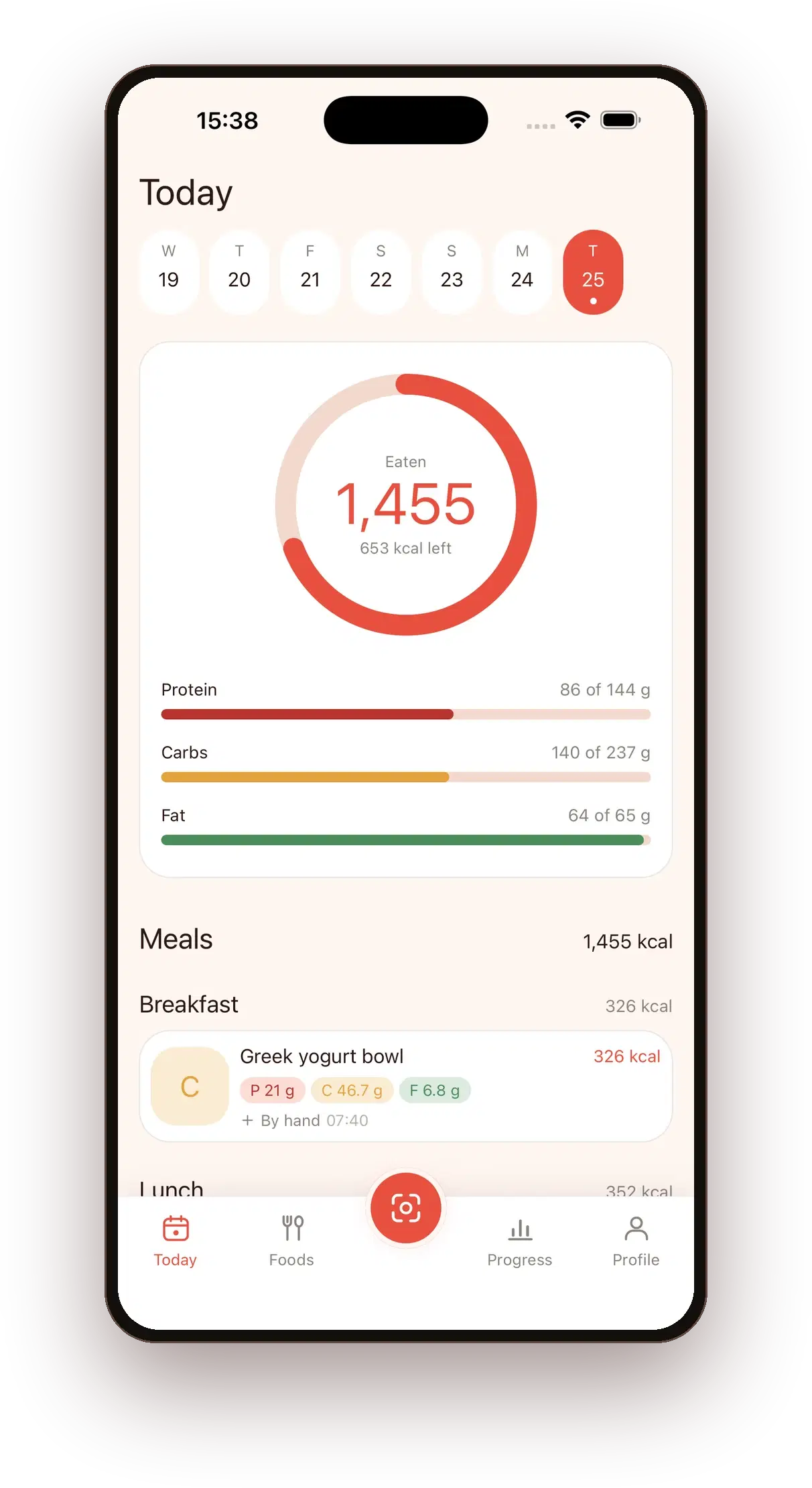
The meal lands in today's diary and counts against your calorie ring and your three macro bars, so you can see what is left before the next meal.
Features
Everything you need to log a day, nothing you don't
Biteline does one job: get the meal into the diary quickly and keep the day's numbers honest.
Photo first
Point your camera at the plate. Biteline names the dish, estimates the portion and breaks it down per ingredient — no searching, no scrolling a database.
Every number is editable
Drag the portion slider and the calories and macros rescale live. Correct the title, adjust a macro, log it. The estimate is a starting point, not a verdict.
A target built for your body
Your height, weight, age, activity level and goal pace produce a daily calorie and macro target — recalculated whenever any of those change.
Protein, carbs and fat — not just calories
Three macro bars sit next to the calorie ring, so a day that hits the calorie number but misses protein still looks like what it is.
Manual logging stays free, forever
Search a food, scan a barcode or type the numbers yourself. The daily cap applies to AI photo scans only.
Weight and streaks over time
Log your weight, watch the trend against your target line, and keep a streak going for every day you log a meal.
Logging works offline
Your diary, your targets and your history live on the device, so you can log a meal on a plane or in a basement restaurant and it syncs when you are back online. Photo recognition is the one part that needs a connection — it runs on our servers, not your battery.
Honest about accuracy
How close is an AI calorie estimate?
Close enough to be useful, not close enough to be treated as fact. Here is what that actually means before you download anything — and we measured it across 30 meals and three vision models rather than asking you to take our word for it.
Grilled salmon, rice & greens — the estimate rescales with the grams you set.
- 260 g413 kcal
- 340 g · estimated540 kcal
- 420 g667 kcal
A 60 g misread on the rice moves the meal by more than a hundred calories. That is why the portion slider is the first control on the result sheet.
It is an estimate, and we say so in the app
A photo cannot see the oil left in the pan, the butter under the fish or the exact weight of the rice. Biteline reads the dish, the ingredients and the apparent portion, then does the nutrition maths. That gets you a well-informed starting number — not a laboratory measurement.
You are the correction step
Portion is the biggest lever on the result, so it is the first thing you can change: drag the slider and every calorie and macro rescales with it. Rename the dish, fix an ingredient, overwrite a macro outright. Whatever you save is what gets logged.
When the number has to be exact, don't guess
Packaged food has the answer printed on the box. Scan the barcode or enter the values by hand and you get the manufacturer's numbers instead of an estimate. Photo recognition is for the plates that have no label.
Consistency beats precision
A log that is slightly off in the same direction every day still shows you the trend — whether you are eating more than you think, and whether that is moving your weight. A perfect log you abandon in week two shows you nothing. Biteline is built to be quick enough that you keep doing it.
Not medical advice. Biteline is a food diary, not a clinical tool. If you have a medical condition, are pregnant, or are managing an eating disorder, talk to a doctor or a registered dietitian before following any calorie target — including the one this app calculates.
Pricing
Free to use. Premium if you scan a lot.
Manual logging is free forever and is never limited. Premium raises the daily cap on AI photo recognition, which is the part that costs us money to run.
Free
The whole tracker, with a daily limit on photo scans.
€0forever
- 3 AI photo scans every day
- Unlimited manual and barcode logging
- Your calculated calorie and macro target
- Calorie ring, macro bars and meal history
- Weight log and streak tracking
- Offline logging
No card needed and no trial to cancel. When you hit the daily scan limit, manual and barcode logging keep working — the app does not stop you tracking your day.
Premium
For anyone photographing most of what they eat.
€89.99per year
Or €9.99 per month — €119.88 a year if you pay monthly. Both plans unlock exactly the same features.
- 20 AI photo scans every day
- Everything in Free, unchanged — nothing is taken away
- Restore your purchase on any device you sign in to
- New features as they ship, at no extra cost
Billed by Apple or Google through your existing account, and cancellable from there in two taps. Cancelling keeps premium running until the period you already paid for ends, and your diary stays intact on the free tier afterwards.
FAQ
Questions people actually ask
They are estimates, and the app treats them that way. Biteline reads the dish and its ingredients from your photo, judges the portion, and does the nutrition maths from there. It cannot see the oil in the pan or weigh the rice, so the number is a well-informed starting point that you are expected to correct. Portion size is the single biggest source of error, which is why the grams slider sits at the top of the result sheet and rescales every macro live as you drag it.
Logging does. Your diary, your daily target, your weight history and your streak live on the device, so you can add a meal on a plane or in a basement restaurant and it syncs the next time you have a connection. AI photo recognition is the exception: reading a photo happens on our servers, so that one step needs internet. If you are offline, log the meal manually and edit it later.
Through the store you bought it from — Settings → your name → Subscriptions on iOS, or Play Store → Payments and subscriptions on Android — in two taps, without contacting us. There is no cancellation fee and no retention maze. You keep Premium until the period you already paid for ends, and after that your account simply returns to the free tier. Nothing in your diary is deleted.
We use it to run the app for you and nothing else. Your meals, weights and targets are stored against your account so they are there on your next device; they are not sold, not shared with advertisers and not used to build a profile of you. There are no ads in Biteline. You can close your account at any time from Profile → Delete my account, which starts the deletion of the account and everything attached to it.
It handles a wide range of home cooking, restaurant plates and street food, not just plain chicken and broccoli. Where any photo-based estimate struggles is with dishes that hide their ingredients — stews, curries, casseroles, anything under a sauce — because what is in the bowl is genuinely not visible. For those you can add a short hint before scanning ("lamb tagine with apricots"), which the model reads alongside the photo, and then correct the ingredient list afterwards.
Yes, and it is free on every plan. For anything packaged, a barcode gives you the manufacturer's own figures rather than an estimate, so it is the more accurate route whenever there is a label to scan. Barcode coverage varies by country and by how obscure the product is; when a code is not recognised you can type the values from the packet and save the food for next time.
It is built for both, from one account — sign in on either and your diary, targets and history are the same. The app is not a browser wrapper: the camera, the diary and the charts are native on each platform, which is why logging still works with no signal.
A photo goes to a private Amazon S3 bucket in Paris, under a path unique to your account with a randomly generated filename, and it is analysed by Amazon Bedrock in the EU — we submit the request to the Paris endpoint and AWS serves it from one of its EU regions — so your photo is stored and read entirely inside the EU, and never goes to the model vendor's own API. No model is trained on it. The storage itself is private: there is no address that opens your photo on its own, and an anonymous request for one is refused outright. When the image genuinely has to be read, our server mints a link signed for a few minutes and nothing else can use it, so a link that escapes in a screenshot or a support ticket expires instead of staying open forever. The photo stays attached to the meal in your diary so you can look back at what you actually ate, it is never surfaced to another user, and deleting the meal — or your account — deletes it.
Something not answered here? contact@getbiteline.com reaches a person.
Your next meal is the easiest one to log
Answer nine quick questions, get a calorie and macro target built around your body, and photograph your first plate. 3 AI scans a day are free, manual logging always is, and there is no card to enter to find out whether it fits your routine.
Biteline is a food diary, not medical advice. Premium is €89.99 per year or €9.99 per month and can be cancelled from your store account at any time.